Singleton Design Pattern
Understanding the Singleton Design Pattern

I am an undergraduate student in Software Engineering at the University of Sri Jayewardenepura. I am skilled in MERN stack development, Java, Spring Boot, and AWS, with hands-on experience as a freelance web developer and educator. Over my journey, I have successfully collaborated with international clients, delivering impactful digital solutions and sharing knowledge through teaching. I am currently seeking a software engineering internship where I can apply my technical expertise, analytical mindset, and teamwork skills to contribute to organizational growth while further advancing my professional development.
What is a Design Pattern?
In software development, a design pattern is a reusable solution to a common problem that occurs in software design.
The main types of Singleton are
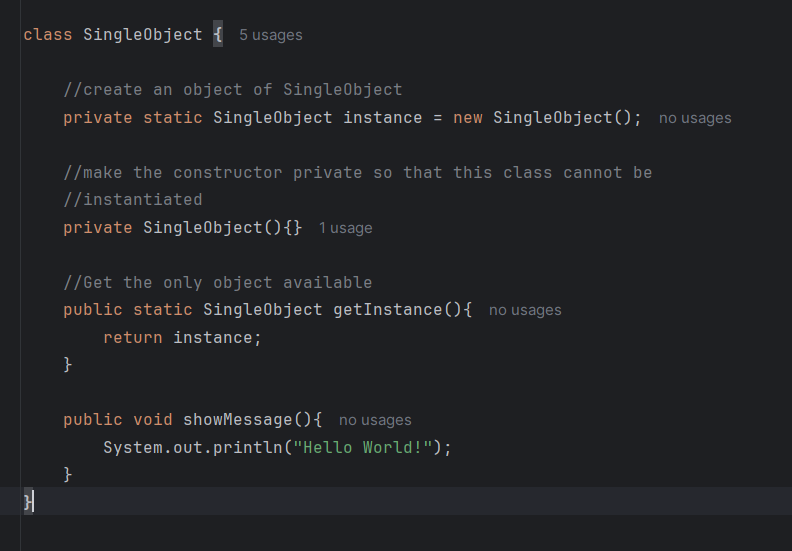
1.Eager Initialization Singleton-Instance is created at class loading time.(Example in below code line)
2.Lazy Initialization Singleton-Instance is created only when first requested.
if (instance == null) {
instance = new LazySingleton();
}
return instance; }
3.Thread-Safe Singleton - Ensures only one instance is created even in multithreaded environments.
Why Do We Need Design Patterns?
1.Provides a common language among developers (e.g., “use a Singleton” Super easy to communicate).
2.Saves time by reusing proven solutions.
3.Leads to cleaner, more organized, and scalable code.
4.Problem-solving - Offers tested ways to tackle common software problems.
What is Singleton Design Pattern?
The Singleton pattern ensures that a class has only one instance throughout the application and provides a global access point to that instance.
In simpler terms:
Only one object is created.
That object can be shared globally.
How Does Singleton Work?
A private constructor restricts direct instantiation of the class.
A static variable holds the single instance.
A public static method often getInstance() provides access to the instance.
So when the client requests an object, instead of creating a new object each time, the same instance is returned.
example code line for Eager Initialization Singleton.👇
What Happens in Singleton?
First call - Instance is created.
Subsequent calls - Same instance is returned (no new object creation).
This saves memory and ensures consistency.
When Should You Use Singleton and Advantages and Disadvantages of Singleton
Use Singleton when you need only one instance of a class shared across the system, like for configuration, logging, or database connections.
Advantages of Singleton
1.Single Instance (Memory Efficiency)
2.Provides a central place to access the instance.
3.Perfect for logging, caching, configuration, or database connection pools where only one instance should exist.
Disadvantages of Singleton
1.Classes become tightly coupled to the Singleton, making the system less flexible and harder to modify.
2.Since it behaves like a global variable, many classes might start depending on it indirectly → makes code harder to understand.
3.In multithreaded environments, two threads could create separate instances if not properly synchronized.
Now that you understand the Singleton pattern and its real-world uses, try implementing it in your own projects!
Start with a Logger, Configuration Manager, or a simple Database class to see how a single instance can improve efficiency and consistency